
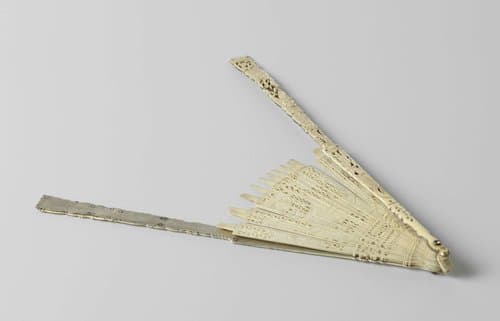
Ivoren montuur ajour gesneden, met in reliëf drie cartouches met Rococo-ornamenten waarin een fruitschaal en tuingereedschap
ca. 1750 - ca. 1770
Medium
cutting
Dimensions
30
Rights
Public Domain
About this artwork
length 30 cm
Art Historical Context
Step into the elegant world of 18th Rococo craftsmanship with this exquisite anonymous ivory mount, titled *Ivoren montuurour gesneden, in reliëf drieouches met Rococo-amenten waarin een fruitschaal en tuingedschap*. Dating to around 1750-1770, this delicately carved frame measures approximately 30 cm in length. openwork (*ajour*) technique creates a lace-like intricacy, pierced through solid ivory to reveal swirling Rococo motifs—think playful scrolls, shells, and floral flourishes framing three raised relief cartouches. Within these, a bountiful fruit bowl evokes abundance and the good life, while garden tools nod to pastoral leisure. Rococo, the opulent successor to Baroque, thrived across Europe in the mid-1700s, celebrating lightness, asymmetry, and nature's whimsy amid aristocratic refinement. Likely Dutch or Northern European in origin, this piece showcases the era's virtuoso ivory carving, a demanding medium prized for its creamy translucency and ability to mimic finer lace or porcelain. The anonymous artisan's skill in balancing negative space with detailed relief highlights the period's love for functional art that doubled as conversation pieces—perhaps framing a mirror, miniature portrait, or snuffbox. Today, this mount whispers of Enlightenment-era indulgence, where everyday objects became canvases for fantasy. Its survival speaks to the enduring allure of Rococo's joyful excess, inviting us to appreciate the hidden hands behind such fragile beauty.
About the Artist
anonymous
In the vast tapestry of art history, "Anonymous" stands not as a singular individual but as a collective designation for countless unidentified creators whose works have endured across millennia. These artists, spanning prehistoric cave painters to medieval illuminators and folk craftsmen, produced the foundational layers of human visual culture. Prior to the Renaissance, when individual fame emer...