
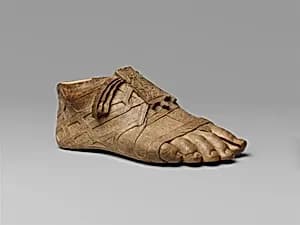
Ivory sandaled foot
Unknown Artist
ca. 31 BCE–14 CE
Medium
Ivory
Dimensions
Overall: 2 3/8 x 5 5/8 in. (6 x 14.3 cm)
Classification
Miscellaneous-Bone, Ivory
Culture & Period
Roman · Early Imperial, Augustan
Department
Greek and Roman Art
Museum
Metropolitan Museum of Art, New York, NY
Credit
Fletcher Fund, 1925
Accession Number
25.78.43
Rights
Public Domain
Tags
Art Historical Context
This delicate ivory carving of a sandaled foot dates to the early years of the Roman Empire, around 31 BCE–14 CE, during the reign of Emperor Augustus. Created in a period when Roman art blended Greek classical ideals with imperial symbolism, the fragment likely formed part of a larger composite statue, furniture inlay, or luxurious decorative object. Its small scale—measuring just over five inches long—suggests it was designed for intimate viewing, perhaps in a private home or temple setting. Ivory was a prized material in the Roman world, imported at great expense and valued for its smooth surface and ability to take fine detail. Carvers used specialized tools to render the sandal straps and anatomical contours with remarkable precision, highlighting both technical skill and the cultural emphasis on naturalistic representation during the Augustan era. Today housed in the Metropolitan Museum’s Greek and Roman department, this modest yet evocative piece illustrates how even fragmentary works can reveal broader insights into Roman aesthetics, trade networks, and the integration of art into daily life.