
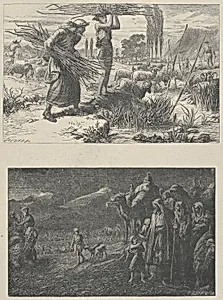
Jacob and the Flocks of Laban–Jacob's Departure from Laban, from "Dalziels' Bible Gallery"
Medium
Wood engraving on India paper, mounted on thin card
Dimensions
Image: 4 5/8 × 7 3/16 in. (11.7 × 18.2 cm) Image: 4 3/16 × 6 7/8 in. (10.7 × 17.5 cm) India sheet: 11 3/16 × 8 11/16 in. (28.4 × 22 cm) Mount: 16 3/8 in. × 12 15/16 in. (41.6 × 32.9 cm)
Classification
Prints
Department
Drawings and Prints
Museum
Metropolitan Museum of Art, New York, NY
Credit
Anonymous Gift, 1926
Accession Number
26.99.1(20)
Rights
Public Domain
Tags
Art Historical Context
This wood engraving, created between 1865 and 1881 by the Dalziel Brothers (with Thomas Dalziel among the key figures), captures a pivotal moment from the Book of Genesis: Jacob’s departure from his uncle Laban, accompanied by his family, servants, and livestock. Published as part of the ambitious “Dalziels’ Bible Gallery,” the print reflects the Victorian era’s fascination with richly illustrated Bibles that brought scriptural narratives to a broad audience through affordable yet finely crafted reproductions. The Dalziel firm was renowned for elevating wood engraving to an art form, working with leading artists to produce detailed images that combined dramatic storytelling with meticulous craftsmanship. Here, the scene’s inclusion of men, women, and camels evokes the journey’s scale and the emotional weight of Jacob’s flight, rendered with the precision possible through engraving on India paper mounted on card. Such techniques allowed for subtle tonal effects and fine lines, making the image both intimate and monumental despite its modest size. Acquired by the Metropolitan Museum of Art through an anonymous gift in 1926, this print exemplifies the 19th-century marriage of religious devotion and commercial publishing, preserving a vivid glimpse of biblical history for generations of viewers.
About the Artist
Camden Press|Scribner and Welford|Dalziel Brothers|Thomas Dalziel (British|American|British) · 1857 |1800 |1839 –1893 |1899 |1893
British, London|New York, NY|British, active 1839–93