
Jacobus Arminius
Unknown Artist
1776 to 1800
Medium
engraving
Dimensions
sheet: 21.5 × 16.6 cm (8 7/16 × 6 9/16 in.)
Classification
Department
CG-E
Museum
National Gallery of Art, Washington, D.C.
Credit
Rosenwald Collection
Accession Number
1950.14.61
Rights
Public Domain
Art Historical Context
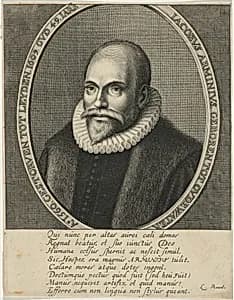
This engraving, created between 1776 and 1800 by an unknown artist, presents a portrait of Jacob Arminius, the influential Dutch theologian whose teachings sparked one of the most significant debates in Protestant history. Arminius (1560–1609) challenged strict Calvinist views on predestination, advocating instead for human free will in matters of faith. Though he lived centuries earlier, this late eighteenth-century print reflects the continued interest in his ideas during the Enlightenment, when religious and philosophical questions remained central to European intellectual life. As an engraving, the work exemplifies a printmaking technique prized for its precision and ability to produce multiple impressions. Engravers used sharp tools to incise fine lines into metal plates, allowing for detailed reproduction of facial features, clothing, and symbolic elements. Such prints played a vital role in disseminating images of notable figures to wider audiences, serving both educational and devotional purposes long before photography existed. Housed in the National Gallery of Art’s Rosenwald Collection, this modest sheet measuring roughly 21.5 by 16.6 centimeters offers viewers a tangible connection to centuries of theological discourse. It reminds us how portrait prints helped shape and preserve the legacies of thinkers whose ideas continue to influence religious thought today.