
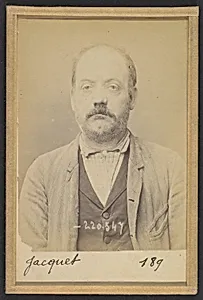
Jacquet. Hippolyte, Edouard. 49 ans, né le 15/3/45 à Paris Ille. Sellier-maroquinier. Anarchiste. 3/7/94.
Medium
Albumen silver print from glass negative
Dimensions
10.5 x 7 x 0.5 cm (4 1/8 x 2 3/4 x 3/16 in.) each
Classification
Photographs
Department
Photographs
Museum
Metropolitan Museum of Art, New York, NY
Credit
Gilman Collection, Museum Purchase, 2005
Accession Number
2005.100.375.217
Rights
Public Domain
Tags
Art Historical Context
This poignant albumen silver print from a glass negative, created by Alphonse Bertillon in1894, captures Hippolyte Édouard Jacquet, a 49-year-old Parisianler and leather worker labeled as an "Anarchiste." Measuring just 10.5 x 7 cm, it is one of Bertillon's meticulously standardized identification photographs, part of his pioneering anthropometric system for criminal records. The detailed inscription—recording Jacquet's birthdate,, and arrest on July 3, 1894—transforms this forensic document into a stark portrait of an individual ensnared by history. Bertillon, chief of the Paris Prefecture's Identification Bureau, revolutionized policing in the late 19th century with his "judicial photography," combining frontal and profile views (though this example focuses intimately on the subject) alongside precise measurements. Amid France's turbulent 1890s "Age of Anarchist Outrages," marked by bombings and political repression, images like this one documented suspected radicals during a crackdown following attacks on public figures. Today, housed in the Metropolitan Museum of Art's Gilman Collection, Jacquet's portrait transcends its origins as police evidence. It exemplifies early photographic precision—albumen prints offered exceptional clarity from glass negatives—and highlights photography's dual role as both tool of control and empathetic record of humanity, inviting us to reflect on the faces behind historical labels.
About the Artist
Alphonse Bertillon · 1853–1914
Alphonse Bertillon (1853–1914) was a pioneering French photographer whose work revolutionized forensic documentation, transforming police identification into a precise visual science. Born in Paris on April 22, 1853, he was the son of medical professor and statistician Louis-Adolphe Bertillon and the younger brother of demographer Jacques Bertillon. Lacking formal higher education after expulsion ...