
1/4
1586 - 1590
Medium
pen
Dimensions
264; 171
Rights
Public Domain
About this artwork
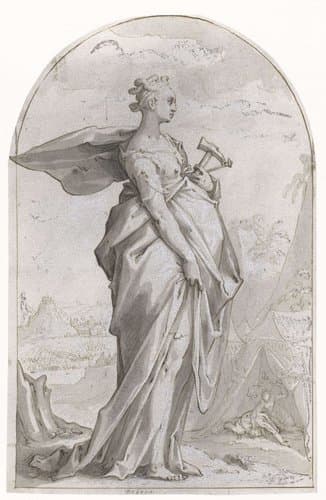
Deze tekening is de eerste uit een serie van vier helden uit het Oude Testament. Het is gegraveerd door Jacob Matham met het opschrift 'Transfigens clauo caua tempora Jahel AEternum e tanto pectore nomen habet'. (B 251). (Catalogus van de Nederlandse tekeningen in het Rijksprentenkabinet, Rijksmuseum Amsterdam, Vol. II)
Art Historical Context
Behold Hendrick Goltzius's pen drawing *1/4* (ca. 1586–1590), the captivating first installment in a series of four Old Testament heroes. Measuring 264 × 171 mm, this work captures Jael, the biblical heroine from Judges 4–5, who boldly slays the Canaanite general Sisera by driving a tent peg through his temple. Goltzius, a Dutch Mannerist artist renowned for his dynamic line work and expressive figures, uses fluid pen strokes to convey tension and heroism, blending classical anatomy with northern European precision. This drawing served as the model for an engraving by Goltzius's pupil Jacob Matham, inscribed with the Latin verse: *Transfigens clauo caua tempora Jahel / AEternum e tanto pectore nomen habet* ("Piercing Sisera's hollow temples with a nail, Jael earns eternal fame from such a valiant heart"; B 251). Created during the late 16th century amid the Dutch Revolt, it reflects the era's fascination with virtuous women warriors, drawing parallels to contemporary struggles for faith and freedom. Housed in the Rijksmuseum's collection, it exemplifies Goltzius's pivotal role in elevating printmaking and drawing as fine arts, bridging Renaissance ideals with emerging Baroque drama. A testament to resilience, this piece invites us to marvel at Jael's unyielding courage.
About the Artist
Hendrick Goltzius · 1558–1617
Hendrick Goltzius (1558–1617) was the most celebrated engraver of the Northern Renaissance and a pivotal figure in Dutch Mannerism. Born near the German-Dutch border, Goltzius transformed printmaking into a virtuoso art form through his revolutionary 'swelling line' technique, where the burin was manipulated to create lines of varying thickness that produced unprecedented tonal effects and three-d...