
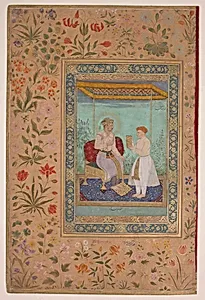
"Jahangir and His Vizier, I'timad al-Daula", Folio from the Shah Jahan Album
recto: ca. 1615; verso: ca. 1530–45
Medium
Ink, opaque watercolor, and gold on paper
Dimensions
H. 15 3/8 in. (39 cm) W. 10 3/16 in. (25.9 cm)
Classification
Codices
Department
Islamic Art
Museum
Metropolitan Museum of Art, New York, NY
Credit
Purchase, Rogers Fund and The Kevorkian Foundation Gift, 1955
Accession Number
55.121.10.23v
Rights
Public Domain
Tags
Art Historical Context
This exquisite folio from the Shah J Album captures a pivotal moment in Mughal history: Emperor Jahangir (r. 1605–27) seated with his trusted vizier,'timad al-Daula, on the recto side, painted by the master miniaturist Manohar around 1615. The verso features stunning Persian calligraphy by the legendary Herat scribe Mir 'Ali Haravi dated circa 1530–45. Housed in the Metropolitan Museum of Art's Art Department, this 15⅜ × 10¼-inch (39 × 25.9 cm) double-sided page exemplifies the Mughal tradition of assembling albums that gathered the empire's finest artworks. Compiled during the reign of Shah Jahan (Jahangir's son), such albums were treasures of imperial patronage, blending Persian influences with Indian realism. Manohar's portrait showcases the Mughal style's precision—delicate ink outlines, vibrant opaque watercolors, and shimmering gold accents that bring the rulers' grandeur to life. I'timad al-Daula, Jahangir's father-in-law and a key administrator, symbolizes the era's blend of politics and artistry. Mir 'Ali's nasta'liq script on the verso, likely poetry, highlights the symbiotic role of calligraphy in Islamic art, where words become visual poetry. Together, these elements reflect the cultural zenith of 17th-century Mughal India, where rulers like Jahangir celebrated both portraiture and verse as paths to immortality.