
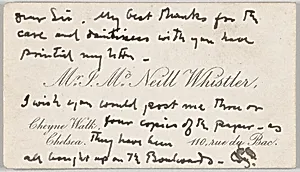
James McNeill Whistler, calling card
ca. 1881–1903
Medium
Engraving
Dimensions
Sheet: 1 1/2 × 2 5/8 in. (3.8 × 6.7 cm)
Classification
Prints|Ephemera|Calling cards
Department
Drawings and Prints
Museum
Metropolitan Museum of Art, New York, NY
Credit
Gift of F. C. Schang, 1977
Accession Number
1977.580.39
Rights
Public Domain
Art Historical Context
Step into the refined world of 19th-century social etiquette this delicate calling card belonging to James McNeill Wh, the renowned American-born artist (1834–1903). Dated around 1881–1903 and measuring just 1 1/2 × 2 5/8 inches, this engraving exemplifies ephemera—everyday printed items that capture a bygone era's customs. Produced via the precise intaglio technique of engraving, where lines are incised into a metal plate for sharp, elegant impressions, it served as Whistler's personal introduction during visits to patrons, friends, or rivals in London's vibrant art scene. Whistler, a leader of the Aesthetic movement, championed "art for art's sake" through his subtle tonal harmonies and Japanese-inspired compositions, as seen in masterpieces like *Arrangement in Grey and Black No.1* (better known as *Whistler's Mother*). His calling card reflects this aesthetic sensibility in its minimalist design, likely featuring his name in refined lettering. In Victorian and Edwardian society, such cards were de rigueur for the upper classes, left at doorsteps to announce one's arrival or request a future call— a ritual blending formality with flair. Housed in the Metropolitan Museum of Art's Drawings and Prints department (gift of F. C. Schang, 1977), this tiny artifact offers a glimpse into Whistler's dandyish persona and the artistry of everyday objects, reminding us how even the ephemeral could embody elegance and cultural prestige.
About the Artist
James McNeill Whistler|Anonymous · 1834–1903
James Abbott McNeill Whistler (1834-1903) was an American-born painter and printmaker who became a leading figure in the Aesthetic Movement and pioneer of Tonalism and Japonisme. He revolutionized art by championing "art for art's sake" and treating paintings as visual equivalents of musical compositions, titling works as "arrangements," "harmonies," and "nocturnes" to emphasize formal qualities o...