
Jar
1796–1819
Medium
Stoneware
Dimensions
9 1/2 × 8 1/2 × 8 1/2 × 6 3/4 in. (24.1 × 21.6 × 21.6 × 17.1 cm)
Classification
Jar
Culture
American
Department
The American Wing
Museum
Metropolitan Museum of Art, New York, NY
Credit
Rogers Fund, 1918
Accession Number
18.95.13
Rights
Public Domain
Art Historical Context
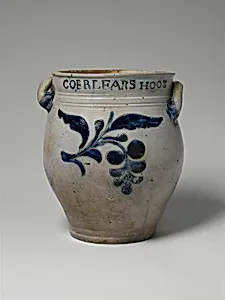
This unassuming yet remarkable stoneware jar, crafted by Thomas W. Commer and David Morgan between 6 and 1819, exemplifies early American pottery from the young nation's industrial awakening. Measuring 9½ × 8½ × 8½ × 6¾ inches, its robust form was designed for practical storage—think flour, grains, or preserves—in colonial and early federal households. Stoneware, at high temperatures to create a dense, impermeable body often salt-glazed for a subtle sheen, represented a leap in American manufacturing, reducing reliance on imported British ceramics after the Revolution. Commeraw and Morgan's collaboration highlights the skilled artisans fueling America's burgeoning craft tradition. Active in a period of economic optimism and westward expansion, their work underscores stoneware's cultural role: durable, utilitarian objects that blended European techniques with local ingenuity. Displayed in The Metropolitan Museum of Art's American Wing (acquired via the Rogers Fund in 1918), this jar invites us to appreciate the everyday artistry of a self-reliant era, where potters like these turned clay into enduring symbols of American resilience.
About the Artist
Thomas W. Commeraw|David Morgan ( |American) · 1796 |1797 –1819 |1802
active 1796–1819|active 1797–1802