
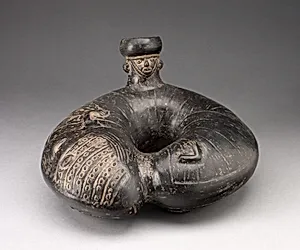
Jar Shaped like an Curling Insect with Single Spout in the Form of a Human Head
1200–1450
Medium
Ceramic
Dimensions
15.2 × 26.7 × 25.7 cm (6 × 10 1/2 × 10 1/8 in.)
Classification
earthenware
Department
Arts of the Americas
Museum
Art Institute of Chicago
Accession Number
6901
Rights
Public Domain
Art Historical Context
This striking Chimú ceramic jar, dating from 1200–1450, exemplifies the imaginative artistry of the Chimú culture, which thrived along Peru's northern coast before the Inca conquest around 1470. Shaped like a curling insect a single spout formed as a human head, the vessel measures 15.2 × 26.7 × 25.7 cm and blends zoomorphic and anthropomorphic elements—a hallmark of Chimú pottery. These hybrid forms likely drew from the culture's rich mythology, where animals and humans intertwined in stories of transformation and the supernatural. Crafted from earthenware, the jar showcases Chimú mastery of modeling and slip-painting techniques, creating smooth, detailed surfaces that capture the insect's segmented body and coiled posture. Such vessels served practical purposes like storing liquids while holding ritual significance, often placed in tombs to accompany the dead into the afterlife. The human-head spout adds a personal, almost portrait-like touch, reflecting the Chimú's skill in portraying individualized features amid their standardized naturalistic style. Housed in the Art Institute of Chicago's Arts of the Americas collection, this piece offers a window into a society famed for its adobe cities like Chan Chan and advanced hydrology. It invites visitors to ponder the ancient worldview where nature and humanity merged seamlessly.
About the Artist
Chimú
The Chimú, a preeminent pre-Columbian culture of Peru's northern coast, flourished from approximately 900 to 1470 CE as the Kingdom of Chimor, emerging in the wake of the Moche civilization's decline and incorporating influences from the Sican, Wari, and Cajamarca cultures. Centered in the vast adobe metropolis of Chan Chan—the largest city in the Americas before the Inca, housing up to 60,000 peo...