
Jar with cover
Unknown Artist
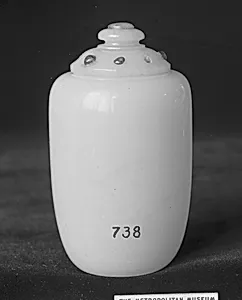
Medium
Nephrite, white with faint greenish tinge
Dimensions
H. 3 1/8 in. (8 cm); W. 1 3/4 in. (4.5 cm)
Classification
Jade
Culture & Period
China · Qing dynasty (1644–1911), Qianlong period (1736–95)
Department
Asian Art
Museum
Metropolitan Museum of Art, New York, NY
Credit
Gift of Heber R. Bishop, 1902
Accession Number
02.18.738a, b
Rights
Public Domain
Art Historical Context
This delicate jar with cover, crafted from nephrite jade—white with a faint greenish t—exemplifies the refined artistry of China's Qing dynasty during the Qianlong period (1736–95). Standing just 3⅛ inches (8 cm) tall and 1¾ inches (4.5 cm) wide, its petite scale suggests it may have held precious cosmetics, snuff, or incense, items befitting elite households. Nephrite, prized for its smooth translucency and subtle color variations, was a material of profound cultural reverence in China, symbolizing purity, immortality, and imperial virtue. The Qianlong era marked a golden age for jade carving, with imperial workshops producing exceptionally polished and intricately worked pieces under the emperor's patronage. Though the artist remains unknown, the jar's flawless surface and harmonious form reflect masterful techniques like careful selection of stone veins and precise hollowing, achieving a luminous glow that enhances its elegant simplicity. Such objects were status symbols, blending utility with aesthetic perfection. Today, this treasure resides in the Metropolitan Museum of Art's Asian Art Department, a gift from Heber R. Bishop in 1902. It invites visitors to appreciate the enduring allure of Chinese jade craftsmanship, where natural beauty meets human ingenuity.