
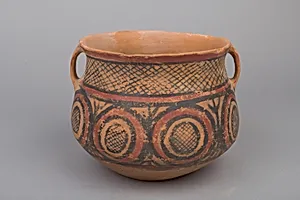
Jar with Spiral Decoration and Cross Hatching
Unknown Artist
Machang type (ca. 2350–2050 BCE)
Medium
Earthenware with pigment
Dimensions
H. 5 1/2 in. (14 cm)
Classification
Ceramics
Culture & Period
China · Neolithic (ca. 3300–2500 B.C.) Majiaoyao phase (3200–2650 B.C.)
Department
Asian Art
Museum
Metropolitan Museum of Art, New York, NY
Credit
Charlotte C. and John C. Weber Collection, Gift of Charlotte C. and John C. Weber, 1994
Accession Number
1994.605.131
Rights
Public Domain
Art Historical Context
This delicate earthenware jar, standing just 5½ inches tall, hails from China's Neolithic Majiaoyao phase (ca. 3200–2650 B.C.), specifically the Mach type (ca. 2350–2050 B.C.). Crafted by an unknown artist in the Gansu-Qinghai region it exemplifies early Chinese pottery traditions where communities transitioned from hunter-gatherer lifestyles to settled farming villages. Such jars were likely used for storing grains, liquids, or ritual purposes, reflecting the era's advancements in agriculture and craftsmanship. The jar's standout features are its bold spiral decorations and intricate cross-hatching, applied with pigments on the fired clay surface—a sophisticated technique for the time. These geometric motifs, painted in black and red tones, demonstrate the Majiaoyao culture's mastery of stylized patterns, possibly symbolizing natural forces like water or fertility. Unlike later glossy porcelains, this unglazed earthenware highlights the raw ingenuity of Neolithic potters, who coiled and burnished clay before adding vibrant designs that have endured millennia. Now part of the Metropolitan Museum of Art's Asian Art collection, gifted by Charlotte C. and John C. Weber in 1994, this jar offers a window into prehistoric China's artistic vitality, bridging utilitarian objects with emerging aesthetic expression.