
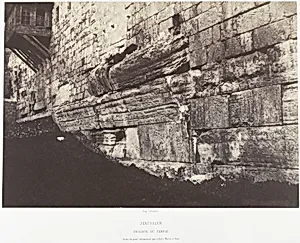
Jérusalem, Enceinte du Temple, Arche du Pont Salomonien qui reliait Moria à Sion
Medium
Salted paper print from paper negative
Dimensions
Image: 23.2 x 32.5 cm (9 1/8 x 12 13/16 in.) Mount: 44.6 x 59.6 cm (17 9/16 x 23 7/16 in.)
Classification
Photographs
Department
Photographs
Museum
Metropolitan Museum of Art, New York, NY
Credit
Gilman Collection, Gift of The Howard Gilman Foundation, 2005
Accession Number
2005.100.373.2
Rights
Public Domain
Tags
Art Historical Context
This striking salted paper print from 1854 captures a panoramic view of Jerusalem's Temple Mount enclosure, featuring the Arch of the Salomonian Bridge that once linked Mount Moriah to Mount Zion. Created by French photographer Auguste Salzmann and published by the Imprimerie photographique de Blanquart-Évrard in Lille, it belongs to Salzmann's groundbreaking series documenting the Holy City's ancient architecture. At 23.2 x 32.5 cm, the image invites viewers into a timeless biblical landscape, evoking the sacred history of Judaism, Christianity, and Islam. As one of the earliest photographs of Jerusalem's sacred sites, taken just a decade after the invention of photography, this work exemplifies the calotype process—using a paper negative to produce detailed salted paper prints. This technique, pioneered by William Henry Fox Talbot, allowed for subtle tonal gradations and expansive compositions, making it ideal for architectural subjects. Salzmann's mission was both artistic and archaeological, preserving fragile monuments amid 19th-century political tensions in the Ottoman Empire. Housed in the Metropolitan Museum of Art's Gilman Collection, this print highlights photography's role in bridging art and scholarship. Visitors can marvel at how it freezes a contested holy site in amber, offering a window into Jerusalem's layered past long before modern preservation efforts.
About the Artist
Imprimerie photographique de Blanquart-Évrard, à Lille|Auguste Salzmann ( |French) · |1851 – |1855
French|French, active 1851–55