
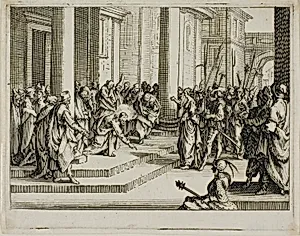
Jesus and the Adulterous Woman, from The New Testament
1635
Medium
Etching on paper
Dimensions
Plate: 6.8 × 8.6 cm (2 11/16 × 3 7/16 in.); Sheet: 7.2 × 9 cm (2 7/8 × 3 9/16 in.)
Classification
etching
Department
Prints and Drawings
Museum
Art Institute of Chicago
Accession Number
80578
Rights
Public Domain
Art Historical Context
In the intimate etching *Jesus and the Adulterous Woman* from Jacques Callot's *The New Testament* series1635), the French Baroque master captures a pivotal biblical moment from John 8:1-11. Here, Christ intervenes as scribes and Pharisees bring a woman accused of adultery before him, challenging her fate with the famous words, "Let him who is sin among you be the first to throw a stone at her." Created just before Callot's death, this tiny plate—measuring only 6.8 × 8.6 cm—exemplifies his late-career focus on moral and religious narratives amid the Counter-Reformation's emphasis on Catholic devotion. Callot, a pioneering etcher renowned for his intricate line work and dynamic compositions, employs his signature technique of fine, cross-hatched lines to pack a bustling scene into minuscule space. Figures crowd the composition with expressive gestures—the accusers poised with stones, the woman humbled, and Christ serene—achieving remarkable depth and drama on paper. Etching, which allowed for precise burr lines and tonal effects, made such detailed prints affordable and reproducible, democratizing Baroque artistry for collectors and the faithful. Housed in the Art Institute of Chicago's Prints and Drawings Department, this work highlights Callot's enduring influence on printmaking, blending technical virtuosity with profound spiritual storytelling. Visitors are invited to lean in close, discovering layers of humanity in its delicate scale.
About the Artist
Jacques Callot · 1592–1635
Jacques Callot (1592–1635) was a French printmaker and draftsman from the Duchy of Lorraine, widely regarded as one of the first great artists to practice the graphic arts exclusively. His more than 1,400 etchings chronicled the breadth of 17th-century life, from Medici court festivities to the brutal realities of warfare. Callot revolutionized etching through technical innovations including the é...