
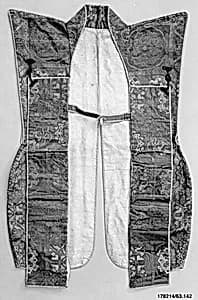
Jimbaori with shokko diaper pattern of dragons, phoenix birds, and stylized "Chinese flowers"
Unknown Artist
19th century
Medium
Silk brocade
Dimensions
40 1/2 x 25 in. (102.9 x 63.5 cm)
Classification
Costumes
Culture & Period
Japan · Edo period (1615–1868)
Department
Asian Art
Museum
Metropolitan Museum of Art, New York, NY
Credit
Rogers Fund, 1963
Accession Number
63.142
Rights
Public Domain
Art Historical Context
This stunning jimbaori, a short jacket worn over samurai armor during Japan's Edo period (1615–1868), exemplifies the opulent craftsmanship of 19th-century warrior attire. Produced in the late Edo era, when peace under the Tokugawa shogunate allowed for elaborate personal expression, these garments blended functionality with prestige. Worn by high-ranking samurai into battle or ceremonial processions, the jimbaori's bold design and luxurious materials underscored the wearer's status and ferocity. Crafted from silk brocade, a technique involving intricate Jacquard-like weaving to create raised, shimmering patterns, this piece features a repeating shokko diaper motif—small, interlocking geometric repeats filled with dynamic dragons, phoenixes, and stylized "Chinese flowers." Dragons symbolize imperial power and rain-bringing strength, phoenixes evoke rebirth and virtue, while the floral elements draw from Sino-Japanese aesthetics, blending cultural influences for auspicious protection. At 40½ x 25 inches, its vibrant palette and metallic threads would have caught the light dramatically on the battlefield. Acquired through the Rogers Fund in 1963 and now in the Metropolitan Museum of Art's Asian Art collection, this anonymous masterpiece offers a window into Edo Japan's fusion of martial tradition and artistic splendor, reminding us how clothing became a canvas for symbolism and skill.