
Job, 2nd plate
1826 to 1850
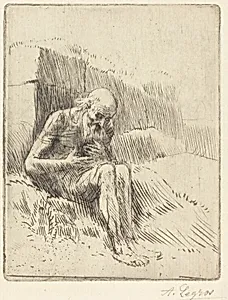
Medium
drypoint and etching? on light green paper
Classification
Department
CG-E
Museum
National Gallery of Art, Washington, D.C.
Credit
Gift of George Matthew Adams in memory of his mother, Lydia Havens Adams
Accession Number
1950.4.22
Rights
Public Domain
Art Historical Context
Alphonse Legros, a prominent 19th-century French-born artist who later worked in Britain, created *Job, 2nd plate* between 1826 and 1850. This evocative print draws from the biblical story of Job, a figure of profound suffering and enduring faith, rendered as the second in a series. As a master of printmaking, Legros contributed to the etching revival, blending meticulous technique with emotional depth, making his works prized for their introspective quality. The medium—drypoint and etching on green paper—highlights Legros's innovative approach. Etching involves acid biting into a metal plate to create precise lines, while drypoint adds a tactile, burr-rich texture for velvety softness, enhancing the dramatic mood of Job's trials. The unusual light green paper lends a subtle, atmospheric tone, uncommon in prints and adding to its visual intrigue. Housed in the National Gallery of Art's CG-E department, this print was a gift from George Matthew Adams in memory of his mother, Lydia Havens Adams. It exemplifies Legros's Realism-influenced style, bridging fine art and reproductive techniques, and invites visitors to ponder timeless themes of resilience amid adversity.
About the Artist
Alphonse Legros · 1837–1911
Alphonse Legros (1837–1911) was born in Dijon, France, and trained in Paris at the drawing school of Horace Lecoq de Boisbaudran, whose unconventional teaching method — which emphasised memory drawing and acute observation over academic convention — would leave a lasting mark on Legros's practice. At Lecoq's school he formed friendships with Jules Dalou and Auguste Rodin that endured throughout hi...