
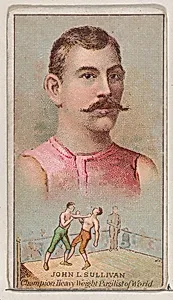
John L. Sullivan, Champion Heavy Weight Pugilist of the World, from the Champions of Games and Sports series (N184, Type 2) issued by W.S. Kimball & Co.
Medium
Commercial color lithograph
Dimensions
Sheet: 2 11/16 × 1 1/2 in. (6.8 × 3.8 cm)
Classification
Prints|Ephemera
Department
Drawings and Prints
Museum
Metropolitan Museum of Art, New York, NY
Credit
The Jefferson R. Burdick Collection, Gift of Jefferson R. Burdick
Accession Number
63.350.216.184.32
Rights
Public Domain
Tags
Art Historical Context
Step into the ring with *John L. Sullivan, Champion Heavy Weight Pugilist of the World*, a vibrant 1887 commercial color lithograph from W.S. Kimball & Co.'s *Champions of Games and Sports* series (N184, Type 2). This petite card, measuring just 2 11/16 × 1 1/2 inches, captures the legendary boxer in his prime, fists raised in triumphant pose. Produced as a promotional insert for Kimball's tobacco products, it exemplifies the era's trading card craze, where sports icons became collectible treasures tucked into cigarette packs. John L. Sullivan, the Boston brawler known as the "Boston Strong Boy," reigned as the last bare-knuckle heavyweight champion and the first under modern gloved rules, embodying the raw energy of 1880s pugilism. Boxing was surging in popularity amid America's growing sports culture, and these cards fueled hero worship among fans, blending athletic prowess with commercial savvy. Part of The Metropolitan Museum of Art's Jefferson R. Burdick Collection, this ephemera highlights how everyday prints immortalized cultural idols. Crafted via chromolithography—a breakthrough technique layering colored inks for vivid, affordable reproduction—this card showcases the artistry of mass production. Its bold hues and dynamic composition reflect late-19th-century advertising's flair, turning a fleeting tobacco premium into enduring museum-worthy history. A snapshot of Gilded Age fandom!
About the Artist
W.S. Kimball & Co.
William S. Kimball & Co. was a tobacco manufacturer based in Rochester, New York, whose influence extended well beyond the cigarette trade into the realm of popular visual culture. Founded in 1846 by William S. Kimball and James C. Hart, the company grew into one of the largest tobacco concerns in the United States, erecting a landmark factory along the Erie Canal on Court Street in 1880. The buil...