
John Perceiving the Seven Candlesticks, from The Apocalypse
1523–24
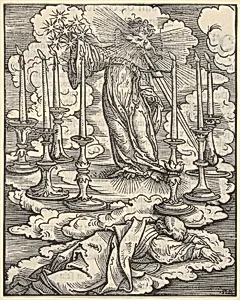
Medium
Woodcut
Dimensions
Sheet: 6 3/8 × 5 1/8 in. (16.2 × 13 cm)
Classification
Prints
Department
Drawings and Prints
Museum
Metropolitan Museum of Art, New York, NY
Credit
The Elisha Whittelsey Collection, The Elisha Whittelsey Fund, 1963
Accession Number
63.705.1
Rights
Public Domain
Tags
Art Historical Context
In the turbulent era of the early Reformation, German artist Hans Burgkma, collaborating with printer Silvan Ot, created *John Perceiving the Sevenlesticks, from The Apocalypse* around 1523–24. This woodcut is part of a series illustrating the Book of Revelation, New Testament's vivid prophetic text attributed to John the Evangelist (often depicted as Saint John). Amid rising religious fervor in the Holy Roman Empire, such prints made apocalyptic imagery accessible, fueling both spiritual devotion and debates over faith. The scene captures John's visionary encounter with seven golden candlesticks symbolizing the churches of Asia Minor, a pivotal moment in Revelation evoking divine mystery and judgment. Burgkmair's Renaissance style blends intricate line work with dramatic composition, characteristic of his innovative woodcuts that bridged late Gothic detail and emerging naturalism. At just 6 3/8 × 5 1/8 inches, this intimate sheet was likely designed for bound volumes, democratizing sacred art for lay audiences. Housed in the Metropolitan Museum of Art's Elisha Whittelsey Collection, this print exemplifies woodcutting's golden age—a technique where carved blocks yielded countless impressions, spreading Reformation-era iconography far and wide. Visitors will appreciate its enduring power to evoke awe and introspection.
About the Artist
Hans Burgkmair|Silvan Otmar · 1473–1531
Hans Burgkmair the Elder (1473–1531) was a German painter and printmaker who became one of the leading artists of the Renaissance in Augsburg. Born into a family of painters — his father, Thoman Burgkmair, was a respected artist — he likely received his initial training in his father's workshop. He may also have studied with Martin Schongauer in Colmar, and a probable visit to Italy around 1507 ex...