
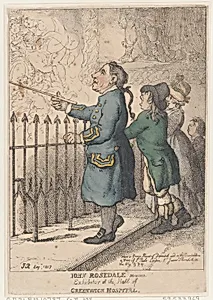
John Rosedale Mariner, Exhibitor at the Hall of Greenwich Hospital
April 26, 1807
Medium
Hand-colored etching
Dimensions
Sheet: 8 11/16 in. × 6 in. (22 × 15.2 cm)
Classification
Prints
Department
Drawings and Prints
Museum
Metropolitan Museum of Art, New York, NY
Credit
The Elisha Whittelsey Collection, The Elisha Whittelsey Fund, 1959
Accession Number
59.533.969
Rights
Public Domain
Tags
Art Historical Context
Thomas Rowlandson's *John Rosedale Mariner,itor at the Hall of Hospital* (April 26, 1807) is a delightful hand-colored etching that captures the artist's signature satirical flair. Measuring just 8 11/16 × 6 inches, this compact print from the Metropolitan Museum of Art's Elisha Whittelsey Collection skewers everyday life with humor, featuring men and women in a naval context. Rowlandson, a leading British caricaturist of the late Georgian era, was renowned for his lively, exaggerated depictions of society, often poking fun at institutions like Greenwich Hospital—a historic home for retired sailors. Created during the Napoleonic Wars, when Britain's seafaring prowess was at its peak, the work likely lampoons a mariner's exhibition or antics in the hospital's grand hall, blending mockery with affection for naval culture. Rowlandson's etchings, hand-tinted for vivid pops of color, amplified their appeal as affordable commentary sold in London shops, making highbrow satire accessible to the public. This piece exemplifies the etching medium's role in 19th-century printmaking: precise lines for dynamic composition, enhanced by watercolor-like coloring to heighten the comedy. A gem of social history, it invites visitors to chuckle at human foibles amid Britain's maritime golden age.
About the Artist
Thomas Rowlandson · 1756–1827
Thomas Rowlandson (1757–1827) was an English artist and caricaturist whose satirical watercolors and prints captured the social life of Georgian Britain with unparalleled wit and technical mastery. Alongside James Gillray, he is recognized as one of the greatest British graphic artists, and his distinctive flowing line and keen observations have made his work integral to understanding late 18th an...