
Jongeman wordt gelauwerd
1766
Medium
etching
Dimensions
182; 109
Rights
Public Domain
About this artwork
ets
Art Historical Context
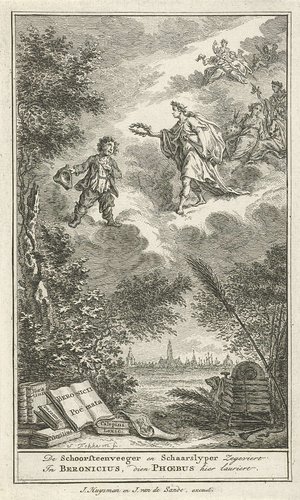
Created in 1766 by Dutch artist Simon Fokke, *Jongeman wordt gelauwerd* captures a timeless moment of honor and achievement. The etching depicts a young man receiving a laurel wreath, a classical symbol of, poetic distinction, or civic recognition drawn from ancient Greek and Roman traditions. At just 182 by 109 millimeters, the intimate scale suggests the work may have been intended as a book illustration or part of a print series meant for private contemplation. Etching was a favored medium in the eighteenth century for its ability to render fine lines and subtle textures with remarkable precision. Fokke, known for his skilled printmaking, used this technique to translate the scene into a widely reproducible format, allowing broader audiences to engage with themes of merit and celebration. The crisp lines and delicate shading typical of the medium bring a sense of immediacy and elegance to the composition. Today the print offers a charming window into Enlightenment-era interest in classical ideals, where personal accomplishment was celebrated through revived ancient imagery. Its modest size and refined execution invite viewers to appreciate both the technical artistry of etching and the enduring cultural resonance of the laurel crown.
About the Artist
Simon Fokke · 1712–1784
Comment on works: Draugstman; Portrait