
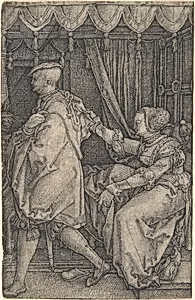
Joseph and Potiphar's Wife
1510–65
Medium
Pen and black ink.
Dimensions
Overall: 4 5/8 x 3 in. (11.8 x 7.6 cm)
Classification
Drawings
Department
Drawings and Prints
Museum
Metropolitan Museum of Art, New York, NY
Credit
The Elisha Whittelsey Collection, The Elisha Whittelsey Fund, 1950
Accession Number
50.605.2
Rights
Public Domain
Tags
Art Historical Context
In the intimate world of Renaissance drawings, Heinrich Aldegrever's *Joseph and Potiphar Wife* (c. 1510–65) captures a pivotal biblical moment from the Book of Genesis. The German artist, a master engraver from Soest known for his precise "Little Masters" style, the virtuous Joseph fleeing the seductive advances of Potiphar's, a tale symbolizing temptation resisted and moral integrity. This small-scale work, measuring just 4 5/8 x 3 inches, invites close viewing, much like a whispered Renaissance secret. Rendered in pen and black ink, Aldegrever employs fine, meticulous lines characteristic of Northern European draftsmanship, blending intricate detail with emotional tension. The medium's directness—without color or elaborate modeling—highlights the figures' dynamic interplay, emphasizing narrative drama over ornamentation. Such drawings often served as studies for prints, showcasing Aldegrever's skill in translating moral stories into accessible art during the Protestant Reformation, when biblical themes underscored personal piety. Housed in the Metropolitan Museum of Art's Drawings and Prints department, this piece from The Elisha Whittelsey Collection exemplifies the era's focus on human drama and ethical storytelling, offering visitors a window into 16th-century devotion and artistry.
About the Artist
Heinrich Aldegrever · 1502–1561
Heinrich Aldegrever, born in 1502 in Paderborn, Westphalia, to parents Herman and Katherine Trippenmeker—a family of clog-makers known by the dialect name Trippenmecker—emerged as a multifaceted artist in the German Renaissance. His early training remains undocumented, though he likely apprenticed in a Soest goldsmith's workshop after relocating there around 1525, where he joined the painters' gui...