
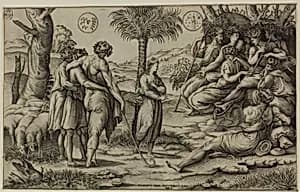
Joseph Explaining his Dreams
Medium
Engraving on paper
Dimensions
23.4 × 37.5 cm (9 1/4 × 14 13/16 in.)
Classification
Department
Prints and Drawings
Museum
Art Institute of Chicago
Accession Number
79901
Rights
Public Domain
About this artwork
Raphael’s fresco from the Vatican Loggia represents an Old Testament narrative from Genesis 37, in which Joseph, the youngest and favorite son of Jacob, ill-advisedly told his 11 brothers about his dreams: in the two hovering circles, 11 sheaves of wheat, representing the other brothers, bow down to Joseph’s sheaf; then even the sun, moon, and stars bow to Joseph. Joseph’s jealous siblings sold him into slavery in Egypt, where he impressed Pharaoh with the same prophetic gifts, saving the realm ...
Art Historical Context
Nicolas Beatrizet’s 1541 engraving “Joseph Explaining his Dreams” a pivotal moment from the story of Joseph in Genesis. The young Joseph is shown recounting his prophetic visions to his family, an episode that sets the dramatic events of his life in motion. Created as a print on paper measuring roughly 23 by 37 centimeters, the work exemplifies the growing importance of engraving in the mid-sixteenth century as a means of sharing religious narratives with a wide audience. As an engraving, the piece highlights the precision and expressive potential of the medium, which allowed artists to render fine details and dramatic lighting effects that could be reproduced many times over. Produced during the Renaissance, such prints played a vital role in disseminating both sacred stories and artistic ideas across Europe. Beatrizet’s careful line work invites viewers to linger on the emotional exchanges between the figures, underscoring the print’s power to make ancient tales feel immediate and personal. Housed in the Prints and Drawings department of the Art Institute of Chicago, this work remains a compelling example of how Renaissance printmakers bridged faith, storytelling, and technical innovation for everyday museum visitors.