
Jozef verklaart de dromen van Farao
Medium
hand coloring
Dimensions
144; 226
Rights
Public Domain
About this artwork
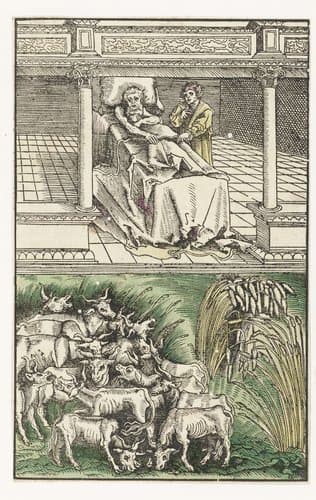
Jozef staat naast het bed van de Farao die wordt gekweld door dromen. Het vertrek waar de Farao zich bevindt is weergegeven als een soort gallerij van waar hij en Jozef kijken naar twee gebeurtenissen in de dromen. Links vooraan worden de vette koeien opgegeten door de magere koeien, rechts buigen de dunne aren zich naar de dikke aren.
Art Historical Context
**Jozef verklaart de dromen vanarao** (1523) is a captivating hand-colored print by Lucas Cranach the, a leading figure of the German Renaissance. Known for his vivid woodcuts, panel paintings, and courtly portraits, Cranach blended Northern Renaissance precision with dynamic storytelling, often drawing from biblical narratives. This small-scale work (226 × 144 mm) captures a pivotal moment from Genesis 41, where Joseph interprets Pharaoh's ominous dreams foretelling famine in Egypt—seven fat cows devoured by seven lean ones, and seven plump ears of grain swallowed by thin onesIn the composition, Joseph stands attentively beside the troubled Pharaoh's bed, set within an architectural gallery that cleverly frames the dream visions. To the left, emaciated cows consume their plump counterparts; to the right, sparse ears bend toward abundant ones. This innovative framing device draws viewers into the prophetic drama, showcasing Cranach's skill in narrative clarity and spatial illusion on a miniature format. Hand-coloring elevates this likely woodcut from black-and-white print to a luminous, painterly gem, a technique popular in 16th-century Northern Europe to mimic illuminated manuscripts. Produced amid the early Reformation, when Cranach supported Martin Luther, it reflects the era's emphasis on accessible religious imagery for personal devotion, inviting museum visitors to ponder themes of divine foresight and human resilience.