
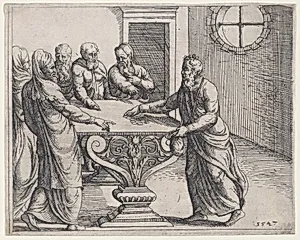
Judas Receiving the Wages of His Treason, from Old and New Testaments
Medium
Etching
Dimensions
Sheet: 4 11/16 × 5 13/16 in. (11.9 × 14.8 cm)
Classification
Prints
Department
Drawings and Prints
Museum
Metropolitan Museum of Art, New York, NY
Credit
Rogers Fund, 1962
Accession Number
62.602.66
Rights
Public Domain
Art Historical Context
This etching by Augustin Hirschvogel captures a pivotal biblical moment from the New Testament: Judas accepting thirty pieces of silver for betraying Christ. Created in 1547 as part of a series illustrating scenes from the Old and New Testaments, the small print (roughly 4 11/16 by 5 13/16 inches) draws viewers into the intimate drama of treachery and consequence. Hirschvogel’s precise line work highlights the tension in the exchange, inviting reflection on themes of loyalty and moral choice that resonated in Reformation-era Europe. Etching allowed artists like Hirschvogel to achieve fine detail and expressive shading on metal plates, making such prints widely accessible beyond church walls or wealthy collectors. In the mid-sixteenth century, this medium helped spread religious narratives to broader audiences through affordable, reproducible images. The work’s modest scale encourages close looking, rewarding museum visitors with subtle textures and expressive figures that underscore the story’s emotional weight. Housed in the Metropolitan Museum of Art’s collection through the Rogers Fund, this print exemplifies how Renaissance artists blended faith, storytelling, and technical innovation. It remains a compelling reminder of how art can illuminate timeless human dilemmas.
About the Artist
Augustin Hirschvogel · 1503–1553
Augustin Hirschvogel (1503–1553) was born in Nuremberg into a prominent family of stained-glass painters who dominated the city's glass workshops during the late 15th and early 16th centuries. The son of Veit Hirschvogel the Elder (1461–1525), Nuremberg's official glazier who executed designs after Albrecht Dürer and Hans von Kulmbach, Augustin trained as a glass painter in his father's workshop. ...