
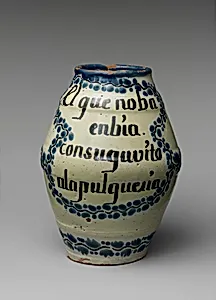
Jug
Unknown Artist
ca. 1800
Medium
Tin-glazed earthenware
Dimensions
H. 7 1/4 in. (18.4 cm)
Classification
Jug
Culture
Mexican
Department
The American Wing
Museum
Metropolitan Museum of Art, New York, NY
Credit
Gift of Mrs. Robert W. de Forest, 1911
Accession Number
11.87.65
Rights
Public Domain
Art Historical Context
This charming tin-glazed earthenware, crafted by an unknown Mexican artist around 1800, stands just 7¼ inches tall, making it a delightful example of everyday artistry from colonial Mexico. The tin-glaze technique—where a tin oxide coating creates an opaque, white surface ideal for vibrant painted designs—was a hallmark of Mexican pottery, influenced by Spanish maiolica methods introduced during the colonial era. Likely produced in regions like Puebla, famous for its talavera wares, this jug would have served practical purposes in households, holding water, wine, or other liquids while doubling as a decorative piece. Its presence in The American Wing of the Metropolitan Museum of Art highlights the interconnected histories of the Americas, as Mexican ceramics often circulated through trade routes to the United States during the early 19th century. Donated in 1911 by Mrs. Robert W. de Forest, a key benefactor of American decorative arts, the jug reflects growing collector interest in folk traditions that bridged European techniques with indigenous craftsmanship. Though modest in scale, it embodies the cultural vibrancy of Mexico's pottery heritage, inviting us to appreciate the anonymous hands that shaped such enduring beauty.