
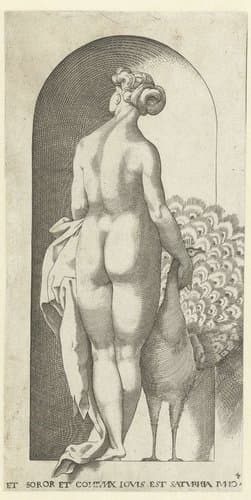
Juno en een pauw
1530
Medium
engraving
Dimensions
212; 108
Rights
Public Domain
About this artwork
verzamelaarsmerk, verso rechtsonder, gestempeld: Lugt 2228a
Art Historical Context
Jacob Binck’s “Juno en een pauw” (Juno and a Peacock) is a finely detailed engraving created in 1530. Measuring just over 21 centimeters in height, the print exemplifies the small-scale reproductive engravings that flourished across Northern Europe during the Renaissance. Binck, a German artist active in the courts of Denmark and Sweden, specialized in such works, translating mythological themes into portable images that could reach wide audiences through the relatively new technology of printmaking. The subject draws on classical mythology: Juno, queen of the gods, is traditionally accompanied by her sacred peacock, whose tail feathers were said to hold the eyes of Argus. In Binck’s composition the goddess stands in elegant contrapposto beside the bird, their forms rendered with crisp lines and delicate hatching typical of early-sixteenth-century engraving. Such prints served both as devotional or decorative objects and as models for painters, goldsmiths, and other craftsmen. Today the sheet carries a collector’s mark (Lugt 2228a) on the verso, reminding us of the long history of connoisseurship that has preserved these fragile works for modern viewers. Through its combination of ancient myth and Renaissance technique, the engraving offers a vivid glimpse into how classical stories were reimagined and disseminated in the sixteenth century.