
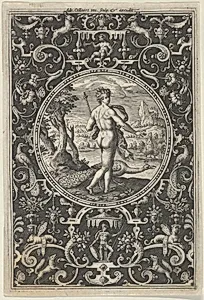
Juno in a Decorative Frame with Grotesques, from the Judgment of Paris
ca. 1580–1600
Medium
Engraving
Dimensions
Sheet: 5 5/8 × 3 13/16 in. (14.3 × 9.7 cm)
Classification
Ornament & Architecture|Prints
Department
Drawings and Prints
Museum
Metropolitan Museum of Art, New York, NY
Credit
Harris Brisbane Dick Fund, 1928
Accession Number
28.44.129
Rights
Public Domain
Tags
Art Historical Context
Adriaen Collaert's *Juno in a Decor Frame with Grotesques from the Judgment of Paris (ca. 1580–1600) is a exquisite engraving from the Metropolitan Museum of Art's Drawings and Prints collection. This small-scale work, measuring just 5 5/8 × 3 13/16 inches, captures the Roman goddess Juno—queen of the gods and protector of marriage—enthroned amid her signature peacocks, all framed by intricate grotesques. Created during the late Renaissance in the Spanish Netherlands, Collaert a master engraver from Antwerp, was renowned for his intricate reproductive prints and ornamental designs that blended mythology with decorative flair. The print draws from the ancient myth of the Judgment of Paris, where the Trojan prince Paris awards a golden apple to the fairest goddess among Juno, Minerva, and Venus, sparking the Trojan War. Here, Collaert spotlights Juno in a lavish architectural niche, surrounded by whimsical grotesques—fantastical motifs of intertwined flora, fauna, and hybrid figures revived from Roman antiquity during the Renaissance. These elements reflect the era's fascination with classical rediscoveries, popularized by artists like Raphael in the Vatican Loggia. Engraving allowed Collaert to achieve fine lines and rich textures, making this piece both a standalone ornament and part of a narrative series. Its cultural significance lies in how it merged mythological storytelling with the vogue for grotesque decoration in prints, furniture, and architecture, influencing Mannerist tastes across Europe. A delightful window into 16th-century artistry!