
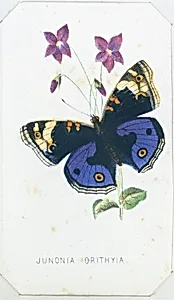
Junonia Orithyia from The Butterflies and Moths of America Part 1
Medium
Color lithograph
Dimensions
sheet: 4 1/8 x 2 3/8 in. (10.4 x 6.1 cm)
Classification
Prints
Department
Drawings and Prints
Museum
Metropolitan Museum of Art, New York, NY
Credit
The Jefferson Burdick Collection, Gift of Jefferson Burdick, 1951
Accession Number
51.650.12(11)
Rights
Public Domain
Tags
Art Historical Context
Behold the delicate *Junonia Orithyia* from *The Butterflies and M of America Part 1*, a charming 1860 color lithograph produced by Louis Prang &. This petite print, measuring just 4 /8 x 2 3/8 inches, captures the intricate beauty of the Junonia Orithyia with vibrant hues and precise detailing. Prang's firm was a pioneer in chromolithography—the art of printing in multiple colors from stone plates—making natural history illustrations like this accessible to a wide audience during America's burgeoning interest in science and education. In the mid-19th century, such prints democratized knowledge of the natural world, serving educators, collectors, and enthusiasts. Chromolithography allowed for stunning reproductions of specimens that rivaled hand-colored engravings but at a fraction of the cost, revolutionizing illustrated books and ephemera. This example, from a serialized publication on American lepidoptera, reflects the era's fascination with entomology, fueled by explorers and scientists documenting the continent's biodiversity. Housed in the Metropolitan Museum of Art's Drawings and Prints department, it forms part of The Jefferson Burdick Collection, generously gifted in 1951. For visitors, this tiny gem offers a window into 19th-century printing innovation and the timeless allure of butterflies—perfect for pondering nature's artistry up close.
About the Artist
Louis Prang & Co. · 1800–1950
Louis Prang & Co. was the Boston printing firm that introduced the Christmas card to the American public and elevated chromolithography to the level of a serious art form. Its founder, Louis Prang (1824–1909), was born in Breslau, Prussia (now Wrocław, Poland), where he trained as a cloth printer and dyer. After participating in revolutionary activity against the Prussian government, he fled first...