
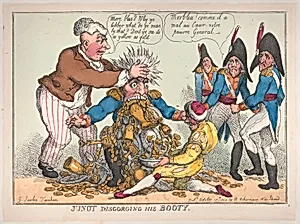
Junot Disgorging His Booty
Medium
Hand-colored etching
Dimensions
Sheet: 10 1/16 × 13 9/16 in. (25.5 × 34.4 cm)
Classification
Prints
Department
Drawings and Prints
Museum
Metropolitan Museum of Art, New York, NY
Credit
The Elisha Whittelsey Collection, The Elisha Whittelsey Fund, 1959
Accession Number
59.533.2072
Rights
Public Domain
Tags
Art Historical Context
Behold *Junot Disgorging Booty*, a hand etching by the renowned Britishaturist Thomas Rowlandson, by Rudolph Ackermann in London on 17, 1808. Measuring about 10 by 13 inches, this satirical print from the Metropolitan Museum of Art's Drawings and Prints collection captures the sharp wit of Georgian-era political commentary. Rowlandson, a master of exaggerated, humorous vignettes, collaborated here with engraver G. Saz Farnham to lampoon French military fortunes during the Napoleonic Wars. The title refers to Jean-Andoche Junot, Duc d'Abrantes, a Bonaparte favorite who led the 1807 invasion of Portugal. After his defeat at the Battle of Vimeiro, the controversial Convention of Cintra allowed the French to return home—booty and all—sparking British outrage. Rowlandson's image depicts Junot comically vomiting up his ill-gotten treasures, symbolizing forced restitution amid public scorn for the "soft" peace terms. Such prints fueled patriotic fervor and anti-French sentiment. Rowlandson's lively etching technique, enhanced by vibrant hand-coloring, exemplifies early 19th-century satire's role in shaping public opinion. Affordable and widely circulated, works like this from Ackermann's Repository of Arts democratized political humor, blending caricature with incisive critique for everyday viewers. A timeless jab at hubris and hypocrisy!
About the Artist
Thomas Rowlandson|G. Saulez Farnham|Jean Andache Junot, duc d'Abrantes|Rudolph Ackermann, London · 1756–1827
Thomas Rowlandson (1757–1827) was an English artist and caricaturist whose satirical watercolors and prints captured the social life of Georgian Britain with unparalleled wit and technical mastery. Alongside James Gillray, he is recognized as one of the greatest British graphic artists, and his distinctive flowing line and keen observations have made his work integral to understanding late 18th an...