
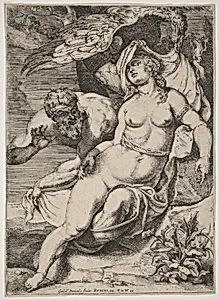
Jupiter and Antiope
Medium
etching on laid paper
Dimensions
sheet: 16.4 x 11.9 cm (6 7/16 x 4 11/16 in.)
Classification
Department
CG-E
Museum
National Gallery of Art, Washington, D.C.
Credit
Gift of the Estate of Leo Steinberg
Accession Number
2011.139.21
Rights
Public Domain
Art Historical Context
Behold *Jupiter and Antiope a captivating etching by Willem Panneels, around 1631 after a painting by the Baroque master Sir Peter Paul Rubens This mythological scene depicts the god Jupiter, disguised as a satyr seducing the mortal Antiope—a classic Rubens motif blending sensuality, drama, and divine mischief drawn from Ovid's tales. Rubens, a Flemish luminary of the early 17th century, was for his exuberant compositions and lush figures, which Panneels faithfully captures here to honor his mentor's vision. Crafted as an etching on laid paper, this intimate print (just 16.4 x 11.9 cm) showcases the precision of 17th-century reproductive printmaking. Etching allowed artists like Panneels, Rubens' apprentice, to translate oil paintings into affordable multiples, spreading the master's influence across Europe. The laid paper's subtle texture enhances the velvety lines and tonal depths, evoking Rubens' signature chiaroscuro and fleshy forms. Housed in the National Gallery of Art as a gift from the Estate of Leo Steinberg, this work highlights the era's cultural fervor for classical mythology and the Baroque's theatrical grandeur. It's a window into how prints democratized high art, inviting all to savor Rubens' timeless allure.