
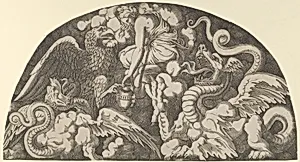
Jupiter's Eagle Bringing Water of the Styx to Psyche
1540–56
Medium
Engraving
Dimensions
Sheet (lunette/trimmed): 8 1/8 × 15 1/16 in. (20.6 × 38.3 cm)
Classification
Prints
Department
Drawings and Prints
Museum
Metropolitan Museum of Art, New York, NY
Credit
The Elisha Whittelsey Collection, The Elisha Whittelsey Fund, 1955
Accession Number
55.590.3
Rights
Public Domain
Tags
Art Historical Context
In the grand tradition of Renaissance mythology, *Jupiter's Eagle Bringing of the Styx toche* captures a pivotal moment from Apuleius's ancient tale of Cupid and Psyche. Designed by the Mannerist master Giulio Romano—pupil of Raphael and architect of Mantua's Palazzo del Te engraved by Léon Davent around 1540–56, the scene depicts Jupiter's eagle fetching the forbidden waters of the River Styx for Psyche. Guarded by fierce dragons, this divine intervention symbolizes Psyche's trials to win back her lover, Cupid, blending classical lore with the era's fascination for dramatic, emotive narratives. As an engraving on a lunette-shaped sheet (trimmed to 8 1/8 × 15 1/16 inches), this print exemplifies 16th-century reproductive techniques. Davent's precise lines after Romano's dynamic composition allowed widespread dissemination of elite designs, making high art accessible beyond frescoes or paintings. Mannerism's elongated forms and intricate details shine here, with the eagle's soaring grace contrasting the serpentine dragons, evoking tension and wonder. Housed in the Metropolitan Museum of Art's Drawings and Prints department (Elisha Whittelsey Collection, 1955), this work highlights engraving's role in preserving Romano's legacy. Visitors can marvel at how it bridges ancient myth and Renaissance innovation, inviting reflection on love's perilous quests.
About the Artist
Giulio Romano|Léon Davent · 1499–1546
Giulio Romano (c. 1499–1546) was the most gifted pupil of Raphael and one of the founding figures of Mannerism, the style that succeeded the High Renaissance in Italy. Born Giulio Pippi in Rome, he entered Raphael's workshop as a boy and proved so talented that by the time of Raphael's death in 1520 he was effectively running the studio and overseeing the completion of major unfinished commissions...