
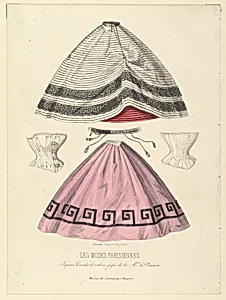
Jupons, corsets et relève jupe de la Maison de Plument, from Les Modes Parisiennes Illustrées
Medium
Steel engraving with hand coloring
Dimensions
Sheet: 10 5/8 x 7 7/8 in. (27 x 20 cm)
Classification
Prints
Department
Drawings and Prints
Museum
Metropolitan Museum of Art, New York, NY
Credit
Harris Brisbane Dick Fund, 1940
Accession Number
40.124.121
Rights
Public Domain
Tags
Art Historical Context
Step into the opulent world of 1860s Parisian fashion with *Jupons, corsets et relève jupe de Maison de Plument*, charming steel engraving with hand coloring from the magazine *Les Modes Parisiennesées*. Created anonymously by a French artist and printed by Imprimerie Moine in1862, this print the intricate undergarments—petticoats (jupons), corsets, innovative skirt lifters (relève jupe)— the esteemed Maison de Plument. the Second Empire under Napoleon III, Paris reigned as the global fashion capital, and such illustrations captured the era's emphasis on elaborate silhouettes, where structured corsets cinched waists to as little as 18 inches, supporting voluminous crinolines and hoop skirts. The medium of steel engraving marked a technical leap forward, allowing for sharper details and higher print runs than traditional copperplate etching, ideal for disseminating the latest trends to an eager middle-class audience. Hand-applied colors add a delicate vibrancy, highlighting fabrics and forms with lifelike allure. This piece, now in the Metropolitan Museum of Art's Drawings and Prints department (thanks to the Harris Brisbane Dick Fund, 1940), offers a window into women's daily adornment and the burgeoning ready-to-wear culture, revealing how fashion plates both inspired and democratized high style.
About the Artist
Anonymous, French, 19th century|Imprimerie Moine · 1800–1900
**Anonymous, French, 19th Century (ca. 1800–1900)** The artist cataloged as Anonymous, French, 19th century embodies the enigmatic yet essential contributions of unidentified creators to France's vibrant 19th-century art world. Active roughly between 1800 and 1900, this figure—or potentially collective workshop—produced a diverse array of works amid the nation's transition from Neoclassicism thro...