
Ka'ba Tile
ca. 1720–30
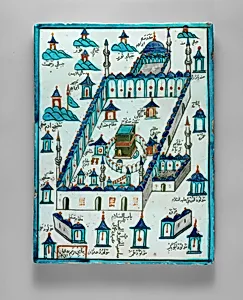
Medium
Stonepaste; polychrome painted under transparent glaze
Dimensions
H: 13.8 in. (35 cm) W: 10.3 in. (26.1 cm)
Classification
Ceramics-Tiles
Department
Islamic Art
Museum
Metropolitan Museum of Art, New York, NY
Credit
Gift of John and Fausta Eskenazi, in memory of Victor H. Eskenazi, 2012
Accession Number
2012.337
Rights
Public Domain
Tags
Art Historical Context
This exquisite *Ka'ba Tile*, around 1720–30 by the skilled Ottoman artisans Osman ibn Mehmed and `Abdullah Mehmed, the sacred Black Cube of Mecca—the holiest site in Islam. Produced during the height of the Ottoman Empire, tiles adorned mosques, mausolea, and royal pavilions, serving as visual pilgrimages for the faithful who could not journey to the Hajj. Measuring 13.8 by 10.3 inches, its depiction of the Ka'ba's architectural grandeur evokes spiritual reverence through intricate architectural details and vibrant hues. Crafted from stonepaste—a durable ceramic body favored in Islamic pottery—the tile features polychrome painting under a transparent glaze, a technique perfected in Istanbul's imperial workshops. This method ensured brilliant, long-lasting colors that resisted fading, allowing the tile's blues, reds, and golds to shimmer like a window to the divine. As part of the Metropolitan Museum of Art's Islamic Art collection, gifted in 2012 by John and Fausta Eskenazi in memory of Victor H. Eskenazi, it exemplifies the fusion of artistry and piety in 18th-century Turkey, inviting visitors to ponder the tile's role in everyday devotion.
About the Artist
Osman Ibn Mehmed|`Abdullah Mehmed (Turkish| ) · 0018 | –0018 |
Turkish, active first half 18th century|