
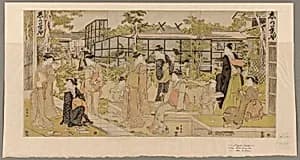
Kacho chaya
c. 1792/93
Medium
Color woodblock print; oban triptych
Classification
woodblock print
Department
Arts of Asia
Museum
Art Institute of Chicago
Accession Number
89476
Rights
Public Domain
Art Historical Context
**Kacho chaya** (Teahouse of Flowers and), created around 1792–93 by Utagawaokuni I, is a vibrant color woodblock print presented as an oban triych—three large sheets that combine into a panoramic scene. Toyokuni, a founding master of the Utagawa, was renowned for his dynamic depictions of kabuki actors, courtesans, and everyday Edo life, blending sharp lines with bold colors to capture the "floating world" (ukiyo-e) of and transience. This artwork exemplifies the golden age of ukiyo-e during Japan's Edo period, when woodblock prints democratized art for urban audiences. Produced through a meticulous process—carving separate woodblocks for each color and layer, then hand-printing and registering them precisely—triptychs like this allowed artists to unfold expansive narratives. Toyokuni's style emphasizes elegance and drama, likely portraying a lively teahouse setting infused with floral and avian motifs, symbols of beauty and harmony in Japanese culture. Housed in the Art Institute of Chicago's Arts of Asia department, **Kacho chaya** highlights Toyokuni's early influence before his school dominated 19th-century printmaking. It invites visitors to immerse in the refined yet playful spirit of Edo entertainment, where art mirrored society's fleeting joys.
About the Artist
Utagawa Toyokuni I · 1777–1835
Japanese, 1777–1835