
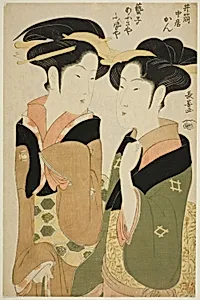
Kan, a waitress of the Izutsuya, and the geisha Fuseya of the Ogiya
c. 1794
Medium
Color woodblock print; oban
Dimensions
37.4 × 24.6 cm (14 11/16 × 9 11/16 in.)
Classification
woodblock print
Department
Arts of Asia
Museum
Art Institute of Chicago
Accession Number
88572
Rights
Public Domain
Art Historical Context
Created around 1794 by Eishosai Choki, this color woodblock print captures two women from Tokyo’s vibrant pleasure quarters during Japan’s Edo period. Choki, active in the late eighteenth century, specialized in bijin-ga, or “pictures of beautiful women,” often portraying courtesans, waitresses, and entertainers with graceful lines and subtle expressions. The oban format, measuring roughly 37 by 25 centimeters, allowed artists to present full-length figures with remarkable detail while remaining affordable for a growing urban audience. The print depicts Kan, a waitress at the Izutsuya teahouse, alongside Fuseya, a geisha from the prestigious Ogiya house. Such pairings were common in ukiyo-e, reflecting the lively social world of restaurants and entertainment districts where women of different ranks interacted daily. Choki’s delicate rendering of their kimono patterns and poised postures highlights both individual elegance and the refined aesthetic ideals of the time. As a woodblock print, the work exemplifies the collaborative ukiyo-e process—designer, carver, and printer working together to achieve luminous colors and crisp lines. Today it offers visitors a vivid glimpse into late-eighteenth-century Japanese urban culture and the enduring appeal of prints that celebrated beauty, fashion, and fleeting moments of pleasure.