
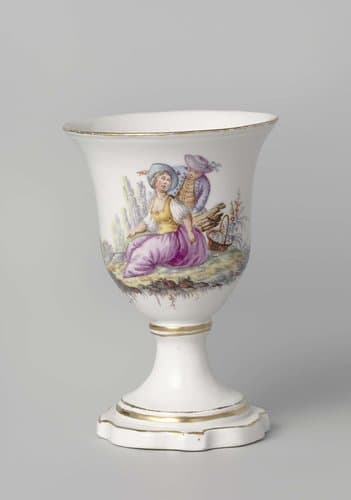
Kandeelkop, beschilderd met een jongen en een meisje
c. 1774 - c. 1778
Medium
porcelain
Dimensions
10.8; 7.3
Rights
Public Domain
About this artwork
Kandeelkop van porselein. Geschulpte voet. De voorkant is veelkleurig beschilderd met eenjongen en een meisje op een grondje, op de achterkant een grondje met struik. Gouden biezen rond de geprofileerde voet en op de nodus.
Art Historical Context
**Kandeelkop, beschilderd met een jongen een meisje** *Manufacture Oud-Loosd, c. 1774–1778, porcelain, h 10.8 cm × d 7.3 cm* This charming porcelain *kandeelkop*—a traditional Dutch candle snuffer—ails from the Manufacture Oud-Loosdrecht, of the Netherlands' pioneering porcelain factories founded in 1774. Nestled in the countryside near Amsterdam, the factory quickly gained renown for producing high-quality hard-paste, rivaling prestigious European centers like Meissen and Sèvres. Crafted during the factory's early years, this petite object (just 10.8 cm tall) reflects the Rococo era's delight in elegant, functional luxury for the home, blending utility with artistic whimsy. The snuffer stands on a scalloped foot with a profiled edge, accented by delicate gold bands that highlight its refined form. Its front bursts with vibrant polychrome enamels depicting a boy and girl standing on a simple ground, evoking pastoral innocence—a popular motif in 18th-century decorative arts. The reverse features a subtle landscape with a bush, adding depth to the composition. These overglaze decorations, fired at low temperatures, allowed for vivid colors and fine details on the glossy porcelain surface. As a snapshot of Dutch ceramic innovation, this piece underscores Oud-Loosdrecht's role in making fine porcelain accessible beyond royalty, adorning bourgeois tabletops. Its intimate scale and joyful scene invite visitors to imagine candlelit evenings in a Golden Age interior, where everyday objects doubled as miniature storytelling canvases.