
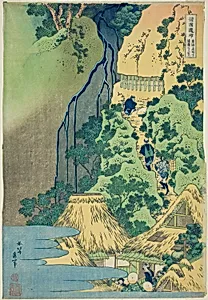
Kannon Shrine at Kiyo Falls at Sakanoshita on the Tōkaidō, from the series Tour of the Waterfalls in Various Provinces (Shokoku taki meguri)
About 1833
Medium
Color woodblock print; ōban
Dimensions
Approx: 38.2 × 25.4 cm (15 × 10 in.)
Classification
woodblock print
Department
Arts of Asia
Museum
Art Institute of Chicago
Accession Number
25189
Rights
Public Domain
Art Historical Context
Katsushika Hokusai's *Kannon Shrine at K Falls at Sakanosh on the Tōkaidō*, from his renowned series *Tour of thefalls in Various Provinces*Shokoku taki meguri captures the majestic power of nature in Edo-period around 1833. The Tōkaidō, a vital coastal highway connecting Edo (modern Tokyo) to Kyoto was a bustling route for travelers, merchants, and pilgrims. Here, Hokusai depicts the cascading Kiyo Falls near Sakanoshita, a small Kannon shrine—dedicated to the compassionate Buddhist bodhisattva—nestled dramatically at its base, blending spiritual reverence with the raw force of water. Printed as an ōban-size color woodblock (approximately 38.2 × 25.4 cm), this ukiyo-e masterpiece exemplifies Hokusai's mastery of the medium. Woodblock printing allowed for vibrant blues, greens, and dynamic contrasts through intricate carving and layering of color blocks, evoking mist, foam, and motion. Hokusai's precise lines and bold compositions highlight his innovative landscape style, part of the ukiyo-e "floating world" tradition that celebrated ephemeral beauty. This print not only reflects Japan's fascination with waterfalls as symbols of impermanence but also underscores Hokusai's global influence, inspiring later Western artists like the Impressionists. A gem in the Art Institute of Chicago's Arts of Asia collection, it invites visitors to ponder nature's awe-inspiring harmony with human faith.
About the Artist
Katsushika Hokusai · 1760–1849
Katsushika Hokusai (1760-1849) stands as one of history's most influential artists, a Japanese master who revolutionized the ukiyo-e woodblock print tradition and profoundly shaped Western art. Born in the Katsushika district of Edo (modern-day Tokyo) to an artisan family, Hokusai lived through nearly nine decades of extraordinary creative evolution, adopting over thirty different artistic names t...