
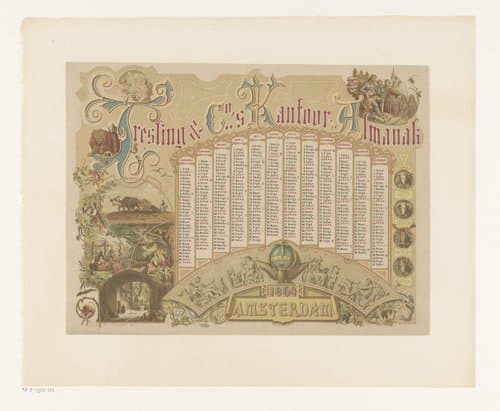
Kantoorkalender met voorstellingen
Medium
color lithography
Dimensions
360; 265; 365; 445
Rights
Public Domain
About this artwork
blad: hoogte 365 mm x breedte 445 mm
Art Historical Context
Created in 1864 by Dutch artist Johannes Henderikus Morriën, *Kantoorkalender met voorstellingen* (Office Calendar with Illustrations) exemplifies the practical elegance of mid-nineteenth-century graphic design. Measuring 265 by 360 millimeters, this color lithograph was designed as a functional yet visually appealing calendar for office use, featuring multiple illustrated scenes across its surface. The slightly larger sheet size of 365 by 445 millimeters indicates it was likely intended for display or binding within a larger album or portfolio. Color lithography, the medium employed here, represented a significant technological advancement during the Industrial Revolution. It allowed artists and printers to produce vibrant, multi-colored images at relatively low cost, making decorative calendars and prints accessible to a broader middle-class audience. Morriën’s work thus bridges fine art and everyday utility, transforming a simple scheduling tool into an object of aesthetic interest. Though details of the specific illustrations remain sparse, the calendar format suggests scenes chosen to inspire or inform the working viewer—perhaps landscapes, historical vignettes, or allegorical figures suited to a professional setting. Such pieces highlight how 19th-century print culture integrated art into daily life.