
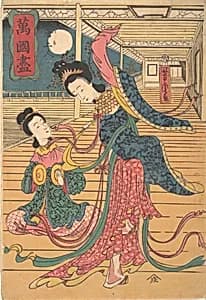
Karajin|Two Chinese Women
12th month, 1860
Medium
Woodblock print; ink and color on paper
Dimensions
Image: 14 1/2 x 10 in. (36.8 x 25.4 cm)
Classification
Prints
Culture & Period
Japan · Edo period (1615–1868)
Department
Asian Art
Museum
Metropolitan Museum of Art, New York, NY
Credit
Bequest of William S. Lieberman, 2005
Accession Number
2007.49.181
Rights
Public Domain
Tags
Art Historical Context
In the waning years of Japan's Edo period (1615–1868), Utagawa Yoshitora crafted *Karajin|Two Women*, a vibrant woodblock print from the 12th month of 1860. As a prolific artist in the ukiyo-e tradition—meaning "pictures of the floating world"—Yoshitor specialized in capturing the ephemeral beauty of actors, warriors, and elegant women. This *nishiki-e* (brocade print), rendered in ink and color on paper, exemplifies the medium's technical mastery: multiple woodblocks were meticulously carved and layered to produce rich, multicolored effects, making art accessible to everyday viewers at affordable prices. The print depicts two poised Chinese women, evoked through the term "karajin" (often denoting foreigners or Chinese in Japanese art). Their flowing robes and refined features reflect Japan's fascination with exotic cultures during a time of isolation under sakoku policy, yet with growing curiosity amid impending Western contacts. Measuring 14½ x 10 inches, the intimate scale invites close admiration of delicate lines and subtle shading, hallmarks of ukiyo-e's bijin-ga (beautiful women) genre. Housed in the Metropolitan Museum of Art's Asian Art Department through the bequest of William S. Lieberman in 2005, this work highlights ukiyo-e's role in preserving cultural ideals of femininity and fantasy, bridging Japan's introspective Edo era to the modernizing Meiji period. A window into 19th-century aesthetics, it captivates with its blend of realism and allure.
About the Artist
Utagawa Yoshitora · 1845–1880
Utagawa Yoshitora (歌川 芳虎), also known by his art names Ichimōsai, Mōsai, and Kinchōrō, was a prolific ukiyo-e artist born in Edo (modern Tokyo), where he trained under the renowned Utagawa Kuniyoshi, recognized as his oldest pupil. Little is known of his early life, which remains sparsely documented, but his earliest works include illustrations for the book *Story of Karasu Kanzaemon’s Loyalty* in...