
Karel VII tot Duits keizer gekroond te Frankfurt
1742
Medium
striking (metalworking)
Dimensions
28.23; 4.4
Rights
Public Domain
About this artwork
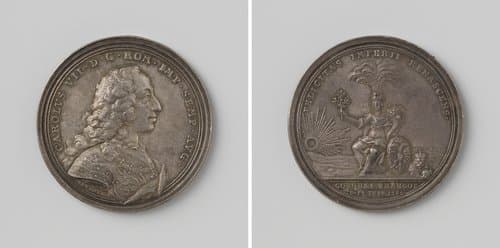
Zilveren penning. Voorzijde: borststuk man binnen omschrift. Keerzijde: gekroonde vrouw zittend tegen palmboom houdt in ene hand lauwertak en in andere hand hoorn van overvloed; links de opgaande zon, rechts een wapenschild en een liggende, gekroonde leeuw met een rijksappel in zijn klauwen binnen omschrift; afsnede: opschrift
Art Historical Context
### Karel VII Crowned as German Emperor in Crafted in 1742 by skilled engraver Andreas Vestner, exquisite silver medal (known as a *penning* in Dutch) commemorates the coronation of Charles VII (Karl Albrecht of Bavaria) as Holy Roman Emperor in. During the turbulent War of the Austrian Succession, Charles's election marked a rare break from Habsburg dominance, symbolizing Bavarian ascendancy and imperial renewal. At just 4.4 cm in diameter and weighing 28.23 grams, these portable treasures were prized collectibles, blending artistry with political propaganda. The obverse features a detailed bust of the emperor within an encircling inscription, capturing his dignified profile with masterful precision. On the reverse, a crowned woman—likely personifying the German Empire—reclines against a palm tree, cradling a laurel branch (for victory) and cornucopia (abundance). A rising sun heralds a new dawn to the left, while a coat of arms and recumbent crowned lion clutching an imperial orb evoke enduring sovereignty. Struck through intricate metalworking techniques, the medal's fine reliefs highlight Vestner's expertise in miniature sculpture. As a snapshot of 18th-century European power struggles, this piece reflects the era's fascination with emblematic medallic art, where symbolism conveyed legitimacy and glory to elites and collectors alike. A testament to craftsmanship amid monarchy's twilight.