
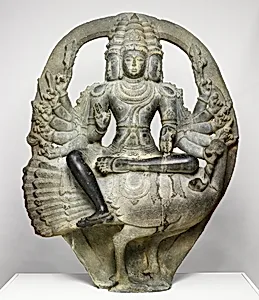
Karttikeya, Commander of the Divine Army, Seated on a Peacock
Ganga Period, about 12th century
Medium
Basalt
Dimensions
150.5 × 121 × 39 cm (59 1/16 × 47 5/8 × 15 3/8 in.)
Classification
stone
Department
Arts of Asia
Museum
Art Institute of Chicago
Accession Number
13853
Rights
Public Domain
About this artwork
Karttikeya, the god of war, is known by various names, including Skanda, Kumara, and Shanmukha, as well as Murugan in southern India, where he is very popular. This monumental basalt sculpture is probably from the Madanapalle region of Andhra Pradesh. Carved in the round and riding a peacock, the commander of the gods is shown with six heads (shanmukha) and twelve arms, ten of which hold weapons aloft. Multiple arms and heads of Hindu deities usually denote their super-human power. According to ...
Art Historical Context
Behold the majestic *Karttikeya, Commander the Divine Army, Se on a Peacock*, a basalt sculpture from India's Ganga Period around the 12th century. This unknown artist's masterpiece captures the Hindu war god Karttikeya—son of Shiva and Parv—in a poised, regal seated posture atop his iconic mount, the peacock. Symbolizing victory and divine prowess, Karttikeya leads the celestial armies against evil, a motif deeply revered in Hindu mythology and temple worship. Carved during the Eastern Ganga dynasty's golden age in Odisha, this 1.5-meter-tall figure exemplifies the period's mastery of hard basalt stone. Artisans employed precise chiseling to render intricate details like flowing garments, jewelry, and the peacock's elaborate feathers, achieving a dynamic balance of volume and grace. The sculpture's frontal composition and stylized anatomy reflect the enduring conventions of Indian temple iconography, where deities were crafted for ritual veneration in grand shrines like those at Konark. Housed in the Art Institute of Chicago's Arts of Asia department, this rare survivor offers a window into medieval India's devotional artistry and cultural splendor. Its enduring presence invites visitors to ponder the timeless blend of spirituality and craftsmanship that defined Ganga-era creativity.
About the Artist
Unknown
The artist designated as "Unknown" in our virtual museum's collection exemplifies a poignant chapter in art history: creators whose identities have faded into obscurity despite the enduring power of their work. With only one known artwork attributed to them in our holdings, this figure represents countless anonymous hands that shaped visual culture across centuries. Museums worldwide, including th...