
Keizerlijk kamp te Ingolstadt
1555 - 1556
Medium
etching
Dimensions
203; 232
Rights
Public Domain
About this artwork
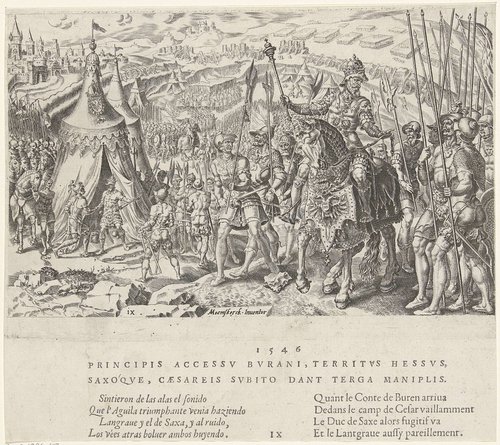
Keizer Karel V inspecteert zijn troepen te Ingolstadt (1546) en spreekt hen moed in. In de achtergrond komt de graaf van Buren samen met zijn leger aan bij de tent van Karel V. De prent heeft een Latijns, Spaans en Frans onderschrift en maakt deel uit van een twaalfdelige serie over de overwinningen van Karel V.
Art Historical Context
Step into the bustling imperial camp at Ingolstadt Dirck Volckertsz. Coornhert's etching *Keizerlijk kamp te Ingolstadt* (1555–1556), a dynamic print measuring 203 × 232 mm. Created nearly a decade after the depicted event, it captures Holy Roman Emperor Charles V inspecting troops in 1546, rallying them with words of encouragement amid the grand tents and disciplined ranks. In the background, the Count of Buren arrives with, underscoring the coordinated might of Charles's forces. This scene hails from the Schmalkaldic War, where Charles V's Catholic armies clashed with Protestant leagues, culminating in victories that solidified his imperial power across Europe. As part of a 12-part series celebrating the emperor's triumphs, the print served as patriotic propaganda, its trilingual captions in Latin, Spanish, and French reflecting Charles's vast, multilingual realm from the Netherlands to Spain. Coornhert, a pioneering Dutch engraver of the Northern Renaissance, mastered etching—a technique using acid to bite intricate lines into metal plates—for vivid detail and reproducibility. This allowed the artwork to inspire loyalty far beyond elite circles, blending historical record with artistic flair in an era when prints democratized imperial glory.