
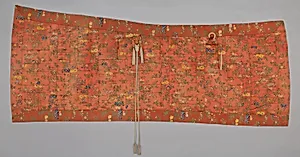
Kesa
Early 19th century, Late Edo period (1789–1868)
Medium
Silk; satin weave with supplementary patterning wefts; silk cords and tassels; ivory ring
Dimensions
134 × 340.6 cm (55 1/2 × 134 in.)
Classification
textile
Department
Textiles
Museum
Art Institute of Chicago
Accession Number
1711
Rights
Public Domain
About this artwork
This kesa was among the first to enter the Art Institute's collection, in 1895. It is noteworthy for its large size, state of completeness (with ring, loop, cords, and tassels), and its pattern showing a profusion of European and Asian flowers. The pattern was made in the kara-ori technique, in which weft-float brocading resembles embroidery. An inscription on the lining states that the kesa was worn by the grand priest of a Buddhist temple.
About the Artist
Unknown
The artist designated as "Unknown" in our virtual museum's collection exemplifies a poignant chapter in art history: creators whose identities have faded into obscurity despite the enduring power of their work. With only one known artwork attributed to them in our holdings, this figure represents countless anonymous hands that shaped visual culture across centuries. Museums worldwide, including th...