
Key
Unknown Artist
1st–7th century
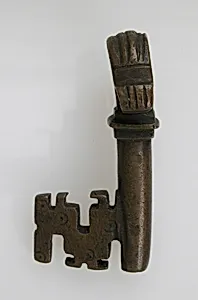
Medium
Copper alloy
Dimensions
Overall: 3 x 1 1/4 x 1 1/2 in. (7.6 x 3.2 x 3.8 cm)
Classification
Metalwork-Bronze
Culture
Roman
Department
Medieval Art
Museum
Metropolitan Museum of Art, New York, NY
Credit
Purchase, De Souhami Collection, Rogers Fund, 1906
Accession Number
06.176.68
Rights
Public Domain
Art Historical Context
This unassuming copper alloy key, crafted by an unknown Roman artisan between the 1st and 7th centuries offers a tangible glimpse into everyday life during the late Roman Empire and early medieval transition. Measuring just 3 x 1¼ x 1½ inches, its compact size suggests it secured personal belongings like chests, doors, or jewelry boxes—essential tools in a world where locks protected wealth and privacy amid expanding trade and urban growth. Forged from durable copper alloy, akin to bronze, this metalwork exemplifies Roman technical prowess in casting and finishing, techniques refined over centuries for both utilitarian and decorative objects. Classified within the Metropolitan Museum of Art's Medieval Art department, it bridges classical antiquity and the early Middle Ages, reflecting the continuity of Roman craftsmanship into Byzantine-influenced eras. Keys like this held practical and symbolic weight, often evoking authority or household guardianship in Roman culture. Acquired in 1906 through the Rogers Fund and De Souhami Collection, this artifact invites us to ponder the ordinary hands that turned it—traders, matrons, or soldiers—preserving a slice of history in its patinaed form. A reminder that even the smallest relics unlock grand narratives.