
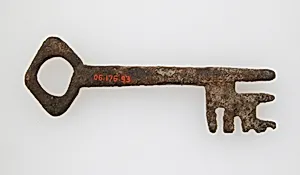
Key
Unknown Artist
1st–7th century
Medium
Iron
Dimensions
Overall: 3 1/16 x 1 3/16 x 1/4 in. (7.8 x 3 x 0.6 cm)
Classification
Metalwork-Bronze
Culture
Roman
Department
Medieval Art
Museum
Metropolitan Museum of Art, New York, NY
Credit
Purchase, De Souhami Collection, Rogers Fund, 1906
Accession Number
06.176.93
Rights
Public Domain
Art Historical Context
This unassuming iron key, dating from the 1st to 7th century, offers a tangible glimpse into everyday Roman life during the transition from classical antiquity the early medieval period. Measuring just 3 1/16 x 1 3/16 x 1/4 inches, its compact size suggests it secured personal belongings, household doors, or chests—practical tools in a world where locks symbolized security and status. Crafted by an unknown artisan, the key exemplifies Roman metalworking techniques, likely forged from heated iron and shaped with simple hammers and chisels, highlighting the era's skilled blacksmiths who produced both utilitarian and ceremonial objects. In Roman culture, keys held deeper significance, often linked to deities like Janus, the god of doors and beginnings, and carried as amulets by women for protection during childbirth. This artifact, classified under metalwork and housed in the Metropolitan Museum of Art's Medieval Art department, bridges pagan traditions and emerging Christian Europe. Acquired in 1906 through the Rogers Fund and De Souhami Collection, it reminds us that history's grand narratives are built on such humble, functional masterpieces—silent witnesses to the ingenuity of ancient daily routines.