
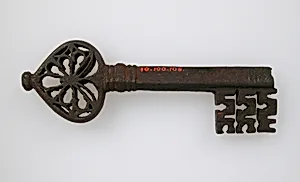
Key
Unknown Artist
15th century
Medium
Iron
Dimensions
Overall: 5 7/16 x 2 x 5/8 in. (13.8 x 5.1 x 1.6 cm)
Classification
Metalwork-Iron
Culture
German
Department
Medieval Art
Museum
Metropolitan Museum of Art, New York, NY
Credit
Rogers Fund, 1910
Accession Number
10.100.106
Rights
Public Domain
Art Historical Context
This unassuming yet remarkable iron key hails from 15th-century Germany, time when the late Middle Ages were giving way to the Renaissance. Measuring just 5 7/16 x 2 x 5/8 inches, it's compact enough to fit in the palm of your hand, yet its sturdy construction speaks to the practical needs of medieval life. Crafted through skilled blacksmithing techniques like forging and possibly filing for precision, such keys were essential for locking doors, chests, or gates, protecting everything from household treasures to ecclesiastical relics. In German medieval culture, keys transcended mere utility—they symbolized authority and trust. Large or ornate examples often belonged to nobles, merchants, or clergy, echoing biblical imagery like the "keys to the kingdom" held by St. Peter. This piece, classified as metalwork, highlights the artistry of anonymous ironworkers who transformed raw ore into functional objects of subtle elegance, blending strength with form. Today, housed in the Metropolitan Museum of Art's Medieval Art department (acquired via the Rogers Fund in 1910), it invites us to appreciate the everyday craftsmanship that defined an era. Far from decorative excess, its simple iron medium underscores the era's mastery of durable, utilitarian design.