
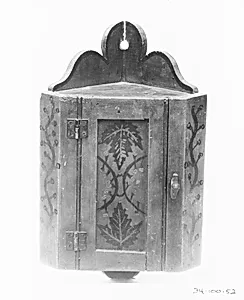
Key Cupboard
Unknown Artist
ca. 1800
Medium
Pine
Dimensions
15 x 8 1/4 x 5 1/2 in. (38.1 x 21 x 14 cm)
Classification
Key cupboard
Culture
American
Department
The American Wing
Museum
Metropolitan Museum of Art, New York, NY
Credit
Gift of Mrs. Robert W. de Forest, 1933
Accession Number
34.100.52
Rights
Public Domain
Art Historical Context
Nestled in The Metropolitan Museum of Art's Wing, this charming *Key Cupboard* (ca. 1800) exemplifies everyday American craftsmanship from the early Federal period. Crafted pine—a lightweight, readily available softwood—this diminutive piece measures just 15 x 8¼ x 5½ inches, suggesting it was designed for wall mounting in a household setting. Its modest scale and practical purpose highlight the ingenuity of anonymous artisans who created functional furniture for the growing middle-class homes of post-Revolutionary America. Dating to around 1800, the cupboard reflects the transition from Colonial simplicity to the refined neoclassical influences of the Federal era, though its unknown maker kept details unadorned, prioritizing utility over ornamentation. Such key cupboards were essential for organizing household essentials like keys, spices, or small tools, underscoring the domestic life of early 19th-century Americans. Pine's warm grain and workability made it ideal for these unpretentious objects, often found in rural or urban dwellings alike. Generously donated in 1933 by Mrs. Robert W. de Forest, this survivor offers a glimpse into America's vernacular decorative arts tradition. Visitors can appreciate how even humble pieces like this preserve the stories of ordinary lives, bridging the gap between fine art and daily utility.