
Key Handle
Unknown Artist
1st–7th century
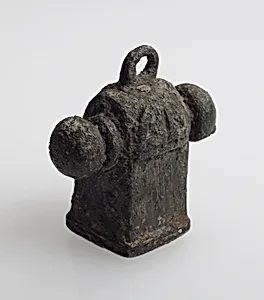
Medium
Copper alloy
Dimensions
Overall: 1 1/2 x 1 7/16 x 3/4 in. (3.8 x 3.7 x 1.9 cm)
Classification
Metalwork-Copper alloy
Culture
Roman
Department
Medieval Art
Museum
Metropolitan Museum of Art, New York, NY
Credit
Purchase, De Souhami Collection, Rogers Fund, 1906
Accession Number
06.176.15
Rights
Public Domain
Art Historical Context
This delicate copper alloy key handle, from the 1st to 7th century, offers a glimpse into the everyday ingenuity of Roman life. Measuring just 1 1/2 x 1 7/16 x 3/4 inches, its compact form suggests it was part of a functional key used for securing doors, chests, or personal belongings—objects that symbolized ownership, privacy, and authority in the Roman world. Crafted during a transitional era from the height of the Empire to early medieval times, it reflects the enduring Roman influence on later European metalworking traditions. Roman artisans excelled in copper alloys like bronze, often employing lost-wax casting or hammering techniques to create precise, durable forms with subtle decorative motifs. Though the exact design details are modest, the handle's survival highlights the technical prowess of ancient smiths, who balanced utility with subtle elegance. Such items were common household tools but could also hold ritual significance, appearing in graves as symbols of the afterlife's secure passage. Housed in the Metropolitan Museum of Art's Medieval Art department, this piece from the De Souhami Collection and Rogers Fund (acquired 1906) bridges classical antiquity and the medieval world, reminding us how small artifacts illuminate vast cultural shifts. A testament to Roman practicality and craft, it invites you to ponder the hands that once gripped it.