
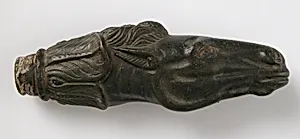
Key Handle in the Form of a Horse’s Head
Unknown Artist
2nd–3rd century
Medium
Copper alloy
Dimensions
Overall: 1 1/4 x 3 5/8 x 13/16 in. (3.1 x 9.2 x 2.1 cm)
Classification
Metalwork-Copper alloy
Culture
Roman
Department
Medieval Art
Museum
Metropolitan Museum of Art, New York, NY
Credit
Purchase, De Souhami Collection, Rogers Fund, 1906
Accession Number
06.176.24
Rights
Public Domain
Tags
Art Historical Context
This exquisite *Key Handle in the Form a Horse’s Head*, in the 2nd–3rd CE, offers a glimpse into everyday Roman life elevated by artistry. Made of copper alloy—a durable, corrosion-resistant metal prized for functional objects—this small piece (just 1¼ x 3⅝ x 13/16 inches) was likely cast using lost-wax techniques, allowing for the intricate modeling of the horse's alert expression, flowing mane, and muscular form. Now housed in the Metropolitan Museum of Art's Medieval Art department (acquired in 1906 via the De Souhami Collection and Rogers Fund), it exemplifies Roman metalwork's blend of utility and symbolism. In Roman culture, horses embodied speed, power, and nobility, often linked to military prowess, chariot racing, and deities like Neptune. Keys themselves were status symbols in a society valuing privacy and security, with zoomorphic handles like this one turning mundane tools into personal talismans. This artifact, from the height of the Empire, highlights how Romans infused daily objects with naturalistic vigor, bridging the practical and the poetic. Though the artist remains unknown, the handle's refined details reflect the era's metallurgical expertise and affection for equine motifs, inviting us to ponder the hand that once gripped it—perhaps a villa owner or traveler securing treasures amid the Empire's vast roads.