
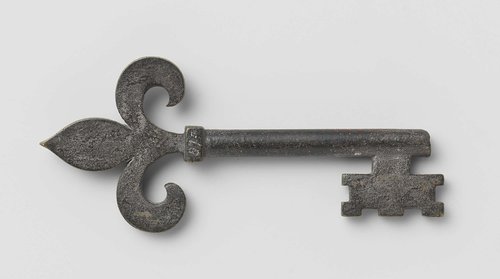
Key with barrel shank
ca. 1800 - ca. 1900
Medium
bronze (metal)
Dimensions
14.2; 6.2
Rights
Public Domain
About this artwork
Pijpsleutel met greep in de vorm van een lelie op een vierkant blokje boven de schacht geplaatst.
Art Historical Context
### Key with Barrel Shank This exquisite bronze pipe key, dating from around 1800 to 1900, measures 14.2 cm in height and 6.2 cm in width. Crafted anonymously, it exemplifies the blend of functionality and ornamentation found in everyday metalwork of the 19th century. "pijpsleutel" (Dutch for pipe key) an essential tool for tobacco pipe enthusiasts, used to adjust or open the bowl of clay pipes popular during the era's smoking culture. Its barrel-shaped shank provided sturdy leverage, while the handle—a delicate lily atop a square block—added elegance to this utilitarian object. The lily motif, perched gracefully above the shank, draws on floral symbolism common in European decorative arts, evoking purity and refinement. Cast in bronze, the key showcases skilled metalworking techniques, likely lost-wax casting, which allowed for intricate detailing on a small scale. Such objects highlight how artisans elevated mundane tools into miniature sculptures, reflecting the period's appreciation for Rococo-inspired embellishments lingering into the 19th century. In a museum context, this key offers a glimpse into daily life, trade, and craftsmanship in Dutch-speaking regions, where tobacco smoking was a social ritual. Its survival underscores the durability of bronze and the charm of anonymous makers who turned the ordinary into the artistic.
About the Artist
anonymous
In the vast tapestry of art history, "Anonymous" stands not as a singular individual but as a collective designation for countless unidentified creators whose works have endured across millennia. These artists, spanning prehistoric cave painters to medieval illuminators and folk craftsmen, produced the foundational layers of human visual culture. Prior to the Renaissance, when individual fame emer...